




How to Install an EPDM Pond Liner — Complete UK Installation Guide
Share
Quick answer
Excavate with smooth sides and marginal shelves, remove stones and roots, lay underlay, then centre the EPDM sheet and let it drape without pulling. Fill slowly, easing neat folds into corners, wait until the liner settles before trimming to about a 30cm overhang, and anchor it under coping or in a trench.
Key facts
- EPDM is sold at 0.75mm and 1.0mm thickness
- Our underlay: 200gsm geotextile; overlap joins by at least 300mm
- EPDM panels are joined with primer and seam tape, overlapping at least 150mm
- Warm the liner in sunlight before fitting; 15°C or above is easiest
- Trim only after the pond is full and the liner has settled
Last reviewed: · Reviewed by the PondLinersco.co.uk team
⚡ Quick Answer
To install an EPDM pond liner: excavate to shape with marginal shelves at 25-30cm depth, lay 200gsm geotextile underlay, drape EPDM centrally, fill slowly while smoothing pleats, trim leaving 30-50cm overlap, then secure under coping stones. Allow 24 hours settling before fitting pumps. EPDM is flexible enough to follow complex shapes. View our pond liners →
✏️ Last updated: April 2025
Installing an EPDM pond liner is one of the most straightforward pond DIY projects available. EPDM's extreme flexibility makes it easier to handle than butyl or HDPE, particularly around complex shapes. The process: excavate, prepare the base, lay underlay, position EPDM, fill slowly while managing folds, and anchor the edges. Seams can be joined on-site with adhesive tape if needed.
Why EPDM Is Easier to Install Than Other Liners
EPDM rubber is the most installer-friendly pond liner material. It remains pliable in cold weather (down to -40°C), folds around corners without cracking, and stretches slightly to follow pond contours. Unlike HDPE, it doesn't require heat welding equipment for seams. Unlike PVC, it won't stiffen and crack at fold points in a UK winter.
Preparation: The Most Important Phase
The preparation phase determines 90% of your installation success. A rushed excavation with sharp stones left in place will cause liner failure regardless of how good the liner is.
- Remove every stone larger than a 5p coin from the excavation
- Remove all plant roots — tree roots especially will penetrate liner over time
- Level the pond edge (critical — use a spirit level and long board)
- Smooth the base — no sharp ridges or sudden drops
EPDM vs Butyl Installation Difficulty
| Factor | EPDM | Butyl | Easier For DIY |
|---|---|---|---|
| Cold weather handling | Excellent — flexible to -40°C | Good — flexible to -20°C | EPDM |
| Weight (per m²) | Lighter | Slightly heavier | EPDM |
| Folding at corners | Very easy — highly elastic | Good | EPDM |
| Seam joining | Tape + primer system | Tape + primer system | Equal |
| Surface texture | Slightly rough (grip) | Smooth | Butyl (easier to slide into position) |
Step-by-Step EPDM Installation
Step 1: Excavate and Prepare
Excavate to your desired shape with smooth sides sloping no steeper than about 45°. Remove all stones, roots, and sharp debris. Check the edge level from multiple directions.
Step 2: Add Sand Layer and Underlay
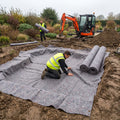
Lay a 50mm sand layer on the base (optional but recommended on stony ground). Drape 200gsm geotextile underlay into the excavation, overlapping joins by at least 300mm and extending 30cm beyond the pond edge.
Step 3: Unroll and Position EPDM
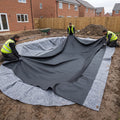
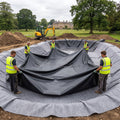
With helpers, position the EPDM sheet centrally over the pond. On a warm day, leave the liner in sunlight for 15–20 minutes to maximise flexibility. Allow the liner to drape naturally into the pond without pulling or stretching it.
Step 4: Fill Slowly and Manage Folds
Begin filling from the centre. EPDM handles beautifully during filling — as water rises, ease the liner into corners with your hands, creating deliberate neat folds at corners rather than random creases. The liner will stretch slightly into contours. Do not force it — let gravity and water weight do the work.
Step 5: Joining Seams (If Required)
For ponds wider than your liner sheet, two panels must be joined:
- Overlap both panels by minimum 150mm
- Clean the overlap area with EPDM primer — allow to become tacky (5–10 minutes)
- Press seam tape firmly onto the primed surface
- Remove the tape backing and press the overlapping panel firmly down
- Roll with a seam roller applying firm pressure throughout
- Apply lap sealant to the seam edge as a final barrier
Step 6: Anchor the Edges
Once filled, trim the liner to leave 30cm overhang. Lay this flat and bed coping stones over it in mortar. Alternatively, bury the liner edge in a 200mm-deep anchor trench filled with compacted soil.
Expert Tips for EPDM Installation
- Avoid walking on the installed liner: Foot traffic on empty liner causes abrasion and micro-tears
- Install on a warm day: 15°C+ makes EPDM most pliable
- Don't cut until settled: Wait until the pond is full and the liner has fully settled before trimming the edges
📚 Related Guides
Related Pond Liner Guides
Shop Pond Liners UK — All Types In Stock
Browse our full range of pond liners — HDPE, EPDM, Butyl, PVC, LDPE and Polyex. All fish safe, UV resistant, and cut to your exact size. Free UK delivery.