




Pond Liner for Stepping Stone Ponds UK — Ecological Network Design & Specification
Share
Quick answer
Stepping stone ponds are mostly shallow (0.1-0.5m, deepest 0.5-0.8m) fish-free wildlife ponds with gently sloping margins. We recommend flexible EPDM 0.75mm, or butyl 0.75mm for permanent sites, with the liner sized at length or width + 2 x max depth + 0.6m.
Key facts
- Keep at least 30% of the pond shallower than 0.3m for amphibian breeding.
- Stepping stone ponds should not contain fish.
- Create a gradual 30-150mm deep shelf around at least half the perimeter.
- Liner size: length or width + (2 x max depth) + 0.6m.
- Remove stones over 15mm from the excavation before laying underlay.
Last reviewed: · Reviewed by the PondLinersco.co.uk team
What Are Stepping Stone Ponds?
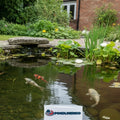
Stepping stone ponds are small to medium-sized ponds — typically 10–100m² — positioned at regular intervals through a landscape to facilitate the movement of aquatic and semi-aquatic wildlife. They are a key tool in ecological network design, particularly for amphibian and aquatic invertebrate conservation in fragmented landscapes.
The Science Behind Stepping Stone Ponds
Research by Pond Conservation (Biggs et al., 2014) and Natural England demonstrates that landscape-scale pond networks — with ponds at 250–500m spacing — support significantly higher amphibian densities and species richness than isolated individual ponds. Stepping stone ponds act as intermediate colonisation sites, maintaining genetic connectivity between larger population centres.
Pond Liner Specification for Stepping Stone Ponds
Size and Depth
- Minimum surface area: 25m² (5m × 5m) for effective ecological function
- Optimal depth: 0.1–0.5m in the majority of the pond (emergent zone) with a maximum depth of 0.5–0.8m in the deepest area
- At least 30% of the pond area should be less than 0.3m deep for amphibian egg-laying and larval development
Liner Material
EPDM-45 fish-safe liner is the recommended specification for stepping stone ponds. Key reasons:
- Fish-safe — critical for ponds intended for great crested newts and other amphibians
- Flexible — allows the gentle, complex margins required for ecological function
- Black colour — ponds warm quickly in spring, promoting early amphibian breeding
- 25-year guarantee — appropriate for a permanent ecological asset
- No fish — stepping stone ponds must not contain fish
Edge Treatment
The liner edge treatment is critical for ecological access. Recommended approach: bury anchor trench at least 1m back from pond margin; create a gradual shelf at 30–150mm depth around at least 50% of the perimeter; use locally-sourced stone or sod to create a natural-looking margin over the liner edge.
Planning and Consent
Small stepping stone ponds (under 0.25 hectares) are typically permitted development in England and do not require planning permission. For ponds near watercourses, an Environmental Permit check is required. For ponds on SSSIs or within designated sites, Natural England consent is needed.
View all pond liners → Cut to size. Free UK delivery.
Pond Survey Methodology for Network Planning
Planning a stepping stone pond network requires a systematic survey of the existing landscape to identify: the highest-value target habitats and species, the most significant connectivity gaps, and the sites where new ponds would have greatest ecological impact.
GIS Mapping for Pond Network Design
Geographic Information Systems (GIS) tools — including free options like QGIS and web-based tools from Freshwater Habitats Trust — allow planners to:
- Map existing ponds from Ordnance Survey and aerial photography
- Identify connectivity gaps (areas without ponds within 500m)
- Overlay land ownership data to identify potential pond creation sites
- Model "least-cost corridors" for amphibian movement between habitat patches
The Freshwater Habitats Trust's "Pond Connectivity Tool" specifically maps potential pond creation sites for great crested newt network expansion and assigns priority scores based on landscape context.
Liner Selection for Long-Term Ecological Success
Stepping stone ponds are intended as permanent ecological assets — a 50-year lifespan is a reasonable expectation for a planned ecological network. The liner specification must reflect this:
| Liner Type | Expected Life | Fish Safe | Suitable for Ecological Network? |
|---|---|---|---|
| EPDM-45 0.75mm | 25+ years (guaranteed) | Yes | Best choice — flexibility, guarantee, fish-safe |
| Butyl 0.75mm | 50+ years (lifetime) | Yes | Excellent — best for permanent assets |
| HDPE 0.35mm | 40–60 years | Yes (inert) | Acceptable — less flexible for complex margins |
| PVC 0.50mm | 10–15 years | Yes (standard grade) | Not recommended — planned replacement disrupts ecology |
| LDPE 0.35mm | 15–20 years | Yes | Marginal — only for budget-constrained situations |
Monitoring and Adaptive Management
A stepping stone pond network requires active monitoring to demonstrate ecological effectiveness and adapt management as needed:
Annual Survey Protocol
- April: GCN eDNA survey (water sample to accredited laboratory) — confirms newt presence/absence without disturbance
- April–May: Torchlight survey and bottle trap survey for amphibians — JNCC standard method
- June: Aquatic invertebrate survey using kick sampling — BMWP index provides water quality and community health score
- July: Aquatic plant NVC assessment — tracks vegetation community development
- Annual: Pond condition assessment against HSI criteria — tracks condition against BNG benchmark
Expert Installation Tips
Based on our experience supplying and supporting hundreds of pond liner installations across the UK, these are the key installation factors that separate good outcomes from poor ones:
Site Preparation
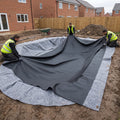
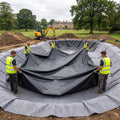
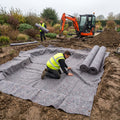
The single most important step — more pond liner failures originate from inadequate site preparation than from any liner defect. Remove all stones over 15mm from the excavated surface. Check for protruding roots, construction debris, and areas of soft ground that could allow settlement under the liner. If in doubt, add a second layer of geotextile underlay.
Sizing the Liner Correctly
Always add more rather than less. The standard formula: Liner Length = Pond Length + (2 × Max Depth) + 0.6m (for 0.3m anchor trench overlap each side). A liner that is 0.5m too short is unusable and requires a full replacement. A liner that is 0.5m too long can have the excess tucked into the anchor trench.
Handling on Site
Carry, do not drag, liner across rough surfaces. Use soft-soled footwear when walking on the liner. Never use metal tools directly on the liner surface. If the liner needs to be repositioned, lift it rather than drag it — even a brief drag across fine gravel can cause invisible micro-scratches that accumulate into weak points.
Filling Sequence
Fill slowly and continuously. Fast filling can trap air under the liner, creating bubbles and stress concentrations. Begin filling at the deepest point, allowing the liner to settle gradually into the pond contour under its own weight as water level rises. Monitor the liner edges throughout filling to ensure they are not being pulled into the pond.
For further guidance on your specific project, contact our specialist team for a free consultation. Browse our full range of pond liners to find the right material for your application.