




Pond Liner for Aquaculture & Fish Farming UK — Complete Specification Guide
Pond Liner for Aquaculture & Fish Farming UK — Complete Specification Guide
Commercial aquaculture operations — including fish farms, trout hatcheries, tilapia units, and prawn farms — have specific pond liner requirements that go beyond those of amenity or garden ponds. The liner must be food-safe, durable under high biological loading, resistant to the cleaning agents and disinfectants used in fish production, and compatible with the stocking densities and water treatment regimes employed.
This guide covers the key specification requirements for pond liners in UK aquaculture applications. For project-specific advice, contact our specialist team.
Regulatory Framework for Aquaculture Pond Liners
Commercial aquaculture operations in the UK are regulated under several frameworks:
- The Aquatic Animal Health (England and Wales) Regulations 2009 — implementing EU Directive 2006/88/EC (retained in UK law), covering disease prevention and biosecurity
- Environmental Permitting Regulations 2016 — most commercial fish farms require an Environmental Permit for water discharge
- Water Resources Act 1991 — prevents pollution of controlled waters; liner integrity is relevant to this requirement
- Food Safety Act 1990 and associated regulations — where fish are produced for human consumption, materials in contact with water must not contaminate the food chain
Food Safety Requirements — NSF 61 and WRAS
For aquaculture operations producing fish for human consumption, the pond liner specification should consider:
- NSF/ANSI 61 — the US standard for drinking water system components; widely referenced for any liner in direct contact with water destined for food production
- WRAS (Water Regulations Advisory Scheme) Approval — UK equivalent for materials in contact with potable water; required for liners used in water supply contexts
- BS 6920 — UK standard for suitability of non-metallic products for use in contact with water intended for human consumption
HDPE geomembranes are the material of choice for commercial aquaculture due to their established food-safe credentials. Quality HDPE manufacturers test their products to NSF 61 or equivalent and can supply certification on request.
HDPE for Aquaculture — Key Properties
HDPE is preferred for commercial fish farming ponds for the following reasons:
- Smooth, non-porous surface — inhibits biofilm accumulation and is easily cleaned and disinfected
- Chemical resistance — resistant to the disinfectants (formalin, potassium permanganate, salt) used in fish health management
- Durability — 25–40 year design life under normal aquaculture conditions
- Weldable seams — hot-wedge welded seams eliminate joint failure under biological pressure
- Inert — does not leach plasticisers, heavy metals, or other contaminants that could affect fish health or food safety
Recommended HDPE Specification for Aquaculture
- Thickness: 0.75mm–1.0mm for raceways and tanks; 0.75mm for earthen ponds
- Type: Smooth HDPE (easier to clean; no texture to harbour debris)
- Colour: Black (standard) or white/light (for visual inspection of fish health)
- Standard: GRI-GM13 compliant; NSF 61 certified preferred
Earthen Pond Lining for Fish Farms
Traditional earthen fish ponds can be lined to:
- Eliminate seepage losses (reducing water consumption by 60–90%)
- Prevent burrowing by eels, crayfish, or predators
- Allow full pond drainage and drying between crops
- Improve biosecurity by eliminating soil-based pathogen reservoirs
- Increase stocking density by improving water quality control
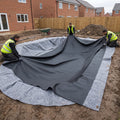
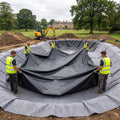
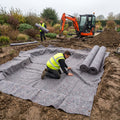
For large earthen ponds, HDPE panels are deployed from rolls and welded in situ. Anchor trenches at the pond perimeter secure the liner against hydraulic uplift and wind during dry periods.
Liner Maintenance in Aquaculture
Lined aquaculture ponds require regular inspection for:
- Seam integrity — inspect annually and after any unusual loading
- UV exposure — if the liner is regularly drained and exposed, UV degradation can occur. HDPE with 2–3% carbon black is UV-stabilised for exposed service.
- Mechanical damage — from maintenance equipment, aeration systems, or fish harvesting
- Anchor trench integrity — ensure liner edges remain secure
Aquaculture Pond Liner FAQ
Is HDPE liner safe for fish intended for human consumption?
Yes — HDPE geomembrane is inert, non-toxic, and does not leach harmful substances into water. It is widely used in drinking water reservoirs, food processing plants, and aquaculture operations worldwide. For critical applications, specify NSF 61 certified HDPE and request the manufacturer's food contact compliance documentation.
Can EPDM be used in aquaculture ponds?
EPDM-45 grade is fish-safe and is used in koi and garden fish ponds, but it is less commonly specified for commercial aquaculture. HDPE is preferred for commercial fish farms because it can be welded to produce leak-free seams, is easier to clean and disinfect, and has greater resistance to the chemicals used in commercial fish health management. EPDM may be appropriate for smaller-scale or organic aquaculture operations.
View HDPE pond liners → | Request aquaculture specification support →
The UK Aquaculture Industry: Scale, Value and Regulation
The United Kingdom supports over 650 licensed fish farms, generating an estimated £500 million or more in annual farmgate value. This figure encompasses freshwater salmonid production (principally Atlantic salmon, rainbow trout, and brown trout), warmwater species including tilapia and ornamental carp, and a growing number of specialist recirculating aquaculture systems (RAS) producing a diverse range of table fish and juveniles for restocking programmes.
Commercial aquaculture in England, Scotland, and Wales is regulated by the Environment Agency (EA) under the Environmental Permitting (England and Wales) Regulations 2016. Farms typically require an Environmental Permit covering abstraction, impoundment, and effluent discharge. In Scotland, equivalent regulation is administered by SEPA (Scottish Environment Protection Agency). These regulatory bodies assess facilities at inception and during periodic reviews, meaning that the physical construction of fish farm ponds — including liner specification — can directly influence permit conditions. Correctly specified HDPE liners that prevent seepage satisfy EA groundwater protection objectives, reducing the risk of permit refusal or restrictive conditions.
Species-Specific Pond Liner Requirements
Different cultured species impose different demands on pond liner materials. Understanding these requirements is critical to selecting the right geomembrane for your fish farm.
Rainbow and Brown Trout
Trout farms are often located in upland areas with exposure to high UV radiation and wide diurnal temperature swings. HDPE geomembrane compounded with carbon black at 2–2.5% offers outstanding UV stabilisation, typically rated to 40–60 years of outdoor exposure. White or light-coloured HDPE is sometimes preferred in indoor hatchery tanks to improve visibility of fish and sediment. Trout require well-oxygenated, cold water (ideally 10–14°C); smooth HDPE surfaces minimise bottom roughness and therefore dead zones where oxygen is depleted.
Tilapia
Tilapia are thermophilic, requiring water temperatures of 25–32°C for optimum growth. In UK RAS facilities, pond and tank liners must resist elevated temperatures without plasticiser migration or dimensional change. High-density polyethylene (HDPE) geomembrane is chemically stable up to 80°C and shows no measurable degradation in water contact between 25°C and 40°C. EPDM rubber liners are also suitable and offer greater flexibility for irregular tank geometries.
Common Carp and Koi
Carp are benthivorous bottom feeders that disturb sediment continuously. In earth ponds this behaviour re-suspends nutrients and pathogens. HDPE-lined ponds eliminate the sediment reservoir that feeds carp-associated pathogens including Aeromonas hydrophila and koi herpesvirus (KHV) reservoirs. Smooth HDPE is easily pressure-washed between crop cycles, reducing the pathogen burden without chemical treatment.
Atlantic Salmon
Salmon farming in freshwater hatcheries relies on consistent oxygen levels and low ammonia. Recirculating systems require tank surfaces that do not harbour nitrifying bacteria colonies beyond controlled biofilter media. Smooth HDPE tank liners minimise uncontrolled surface biofilm and allow effective chemical disinfection between batches. For outdoor holding ponds, HDPE's impermeability means that groundwater — which in Scotland may carry Gyrodactylus salaris risk — cannot infiltrate the system.
HDPE Liner vs Earth Ponds: Productivity Comparison
The productivity difference between lined and unlined fish farm ponds is well-documented. Earth ponds suffer from:
- Seepage losses of 10–30% of water volume per day in permeable soils, requiring continuous make-up water abstraction
- Turbidity from bottom disturbance reducing feeding activity and increasing stress
- Uncontrolled nutrient release from anaerobic sediments
- Difficulty maintaining biosecurity between crop cycles
HDPE-lined ponds typically achieve 25–40% higher stocking densities compared to equivalent unlined ponds, due to improved water quality management. Published aquaculture research indicates that yield per m² of water surface can increase from 3–5 kg/m² in earth ponds to 8–15 kg/m² in lined, aerated ponds with equivalent feed inputs. Over a 5-year production cycle, the incremental yield improvement more than recovers the capital cost of lining.
Liner Installation for Recirculating Aquaculture Systems (RAS)
Recirculating aquaculture systems (RAS) operate tanks and raceways at high fish densities, with 95–99% water recirculation after biological filtration. The liner specification for RAS components differs from open pond applications:
Circular Tanks
RAS circular tanks (typically 3–10m diameter, 1–1.5m deep) are commonly constructed from fibreglass, polyethylene, or concrete. Where concrete is used, HDPE geomembrane liner panels can be bonded to the internal surface using proprietary adhesives, providing a smooth, impermeable, and chemically resistant finish. Panel welding is achieved using hot-wedge or extrusion welding to produce a continuous membrane with no leak paths.
Raceways
Rectangular raceways (often 20–50m long, 2–4m wide) are lined with HDPE geomembrane anchored at the top of the sidewalls with anchor trenches or mechanical fixings. Critical design considerations include drainage outlets that do not create puncture risks and inlet structures that avoid membrane uplift from hydraulic pressure. A protective geotextile underlay (300–500 g/m²) is recommended beneath the HDPE to cushion against sub-base irregularities.
Biofilm Management in Fish Farm Ponds
Biofilm — the complex community of bacteria, protozoa, and extracellular matrix that colonises submerged surfaces — poses a significant biosecurity challenge in aquaculture. In earth ponds, the porous soil matrix provides an enormous surface area for pathogenic biofilm development, with Flavobacterium columnare, Saprolegnia spp., and Aeromonas spp. persisting between production cycles.
Smooth HDPE geomembrane (surface roughness Ra <1.6 µm) presents a low surface energy substrate that inhibits biofilm adhesion compared to concrete (Ra 50–200 µm) or compacted earth (Ra >500 µm). While biofilm cannot be entirely eliminated on any surface in contact with water, HDPE-lined ponds can be effectively decontaminated between crops using:
- High-pressure washing (minimum 100 bar) to remove visible biofilm
- Chlorine-based disinfectants (sodium hypochlorite 200–500 ppm) with 30-minute contact time
- Drying and UV exposure where pond geometry permits
Disinfection Chemical Compatibility
Fish farms routinely use a range of disinfection and treatment chemicals that must be compatible with the pond liner material:
Formalin (Formaldehyde Solution)
Formalin (typically 36–40% formaldehyde in water) is an authorised veterinary medicine used in UK fish farms to treat external parasites including Ichthyophthirius and Gyrodactylus. HDPE geomembrane demonstrates excellent resistance to formalin at concentrations used in aquaculture (50–250 ppm treatment baths). EPDM rubber also shows good short-term resistance. PVC liners may absorb formaldehyde over prolonged contact, leading to surface degradation; butyl rubber shows moderate resistance. Where formalin treatment is a regular protocol, HDPE is the preferred liner material.
Other Chemicals
Hydrogen peroxide (H₂O₂, licensed for sea lice and gill disease treatment), potassium permanganate (KMnO₄, used for external parasite treatment), and iodophors (used for egg disinfection) are all compatible with HDPE geomembrane at aquaculture concentrations. Lime (calcium hydroxide, Ca(OH)₂) used for pond disinfection between crops is also fully compatible with HDPE, EPDM, and butyl liners.
Water Temperature Management: Black vs White HDPE
In cold-climate trout and salmon farms — particularly in Scotland and upland England — liner colour influences pond water temperature:
- Black HDPE: Absorbs solar radiation, raising water temperature by 1–3°C above ambient. Beneficial in spring to accelerate growth rates to target size; potentially problematic in summer if temperatures approach trout thermal stress thresholds (18°C).
- White or light-grey HDPE: Reflects solar radiation, maintaining cooler water temperatures. Preferred for hatchery tanks where precise temperature management is critical and for summer pond use in southerly climates.
- Textured HDPE: Available in dark green or brown, providing ecological benefits such as reduced reflective glare that disturbs foraging birds and improved visual integration with the landscape — relevant for farms in National Parks or AONB designations.
Liner Maintenance Schedule for Commercial Fish Farms
A structured maintenance regime maximises liner service life and regulatory compliance:
| Frequency | Task |
|---|---|
| After each crop cycle | Full visual inspection, high-pressure wash, repair any punctures or seam failures before refilling |
| Annually | Electrical leak detection (ELD) survey on ponds >500m²; document findings for EA permit compliance |
| Every 3 years | Independent CQA audit; review seam integrity; update as-built drawings |
| Every 10 years | Consider full liner replacement assessment; check against manufacturer's design life documentation |
Pond Drainage and Harvest Procedures
The smooth, impermeable surface of an HDPE-lined pond fundamentally changes harvest operations compared to earth ponds:
- Complete draindown: Unlike earth ponds where residual water pools in depressions, HDPE-lined ponds with correctly graded sub-bases drain completely via a single drainage sump, ensuring full fish recovery and eliminating the "last fish" problem common in earth ponds.
- Netting efficiency: Nets drag cleanly across HDPE without snagging on roots, stones, or burrowing invertebrates. Harvest times are typically 30–50% shorter than in comparable earth ponds.
- Predation prevention: Smooth pond sides without vegetated margins are less attractive to otters, herons, and cormorants. HDPE-lined ponds are more readily screened with anti-predator fencing due to clean perimeter geometry.
Economics: Cost/Benefit Analysis of Lining an Earth Pond
The capital case for lining an existing earth fish farm pond is compelling when examined over a 5-year horizon:
| Factor | Typical Range |
|---|---|
| Lining cost (supply and install, 1,000–5,000m²) | £8,000–£25,000 |
| Incremental yield improvement (25–40% uplift) | £15,000–£50,000 over 5 years |
| Water savings (reduced abstraction licence) | £500–£3,000/year |
| Reduced biosecurity costs (fewer disease treatments) | £1,000–£5,000/year |
| Payback period | Typically 2–4 years |
These figures are indicative and will vary with species, location, and existing infrastructure. A detailed investment appraisal should be prepared by a qualified aquaculture consultant.
Case Study: Scottish Salmon Hatchery HDPE Lining Project
A Highland-based Atlantic salmon hatchery operating 12 earth ponds totalling 4,800m² undertook a phased HDPE lining programme over two seasons. The existing earth ponds suffered from seepage rates of approximately 18% daily volume loss, requiring continuous groundwater abstraction at significant licence cost. Turbidity from bottom disturbance was identified as a key driver of sub-optimal smolt quality and elevated sea lice burdens at sea transfer.
Following specification of 1.5mm textured HDPE geomembrane with 300 g/m² non-woven geotextile underlay, the hatchery achieved:
- Seepage reduced to below detection limits
- Water clarity improved from 30–50 NTU to consistently <5 NTU
- Smolt survival to sea transfer improved from 78% to 91%
- Biosecurity significantly enhanced: the facility achieved Specific Pathogen Free (SPF) status for Infectious Pancreatic Necrosis (IPN) within two seasons of lining completion
- Total project cost: £19,500; estimated first-year return from improved smolt quality: £28,000
Environment Agency Aquaculture Licensing: Environmental Permit Requirements
English fish farms producing more than 2,000 kg of fish per year, or those abstracting more than 20m³/day, require an Environmental Permit from the Environment Agency. Key requirements relevant to pond liner specification include:
- Groundwater protection: EA guidance requires that fish farm effluent (including seepage from pond bases) does not cause deterioration in groundwater quality. HDPE-lined ponds, by preventing seepage, directly satisfy this requirement.
- Source Protection Zones (SPZ): In SPZ1 and SPZ2 areas (the most sensitive groundwater protection zones), EA may require impermeable pond lining as a condition of permit approval.
- Water Framework Directive (WFD) compliance: EA uses WFD objectives to assess permit applications. Demonstrably lower effluent loads from lined ponds support WFD compliance arguments.
- Bioassay and water quality monitoring: Conditions typically include periodic water quality monitoring; clean HDPE-lined ponds produce more consistent effluent quality, simplifying compliance.
Ready to Specify Your Aquaculture Pond Liner?
Our technical team has supported fish farms across Scotland, England, and Wales in specifying the correct geomembrane for their production systems. Whether you need HDPE for a trout raceway, EPDM for a koi holding pond, or specialist white liner for a heated tilapia RAS, we can provide material samples, installation guidance, and competitive pricing.
Browse our aquaculture pond liner range or contact our technical team for expert advice.