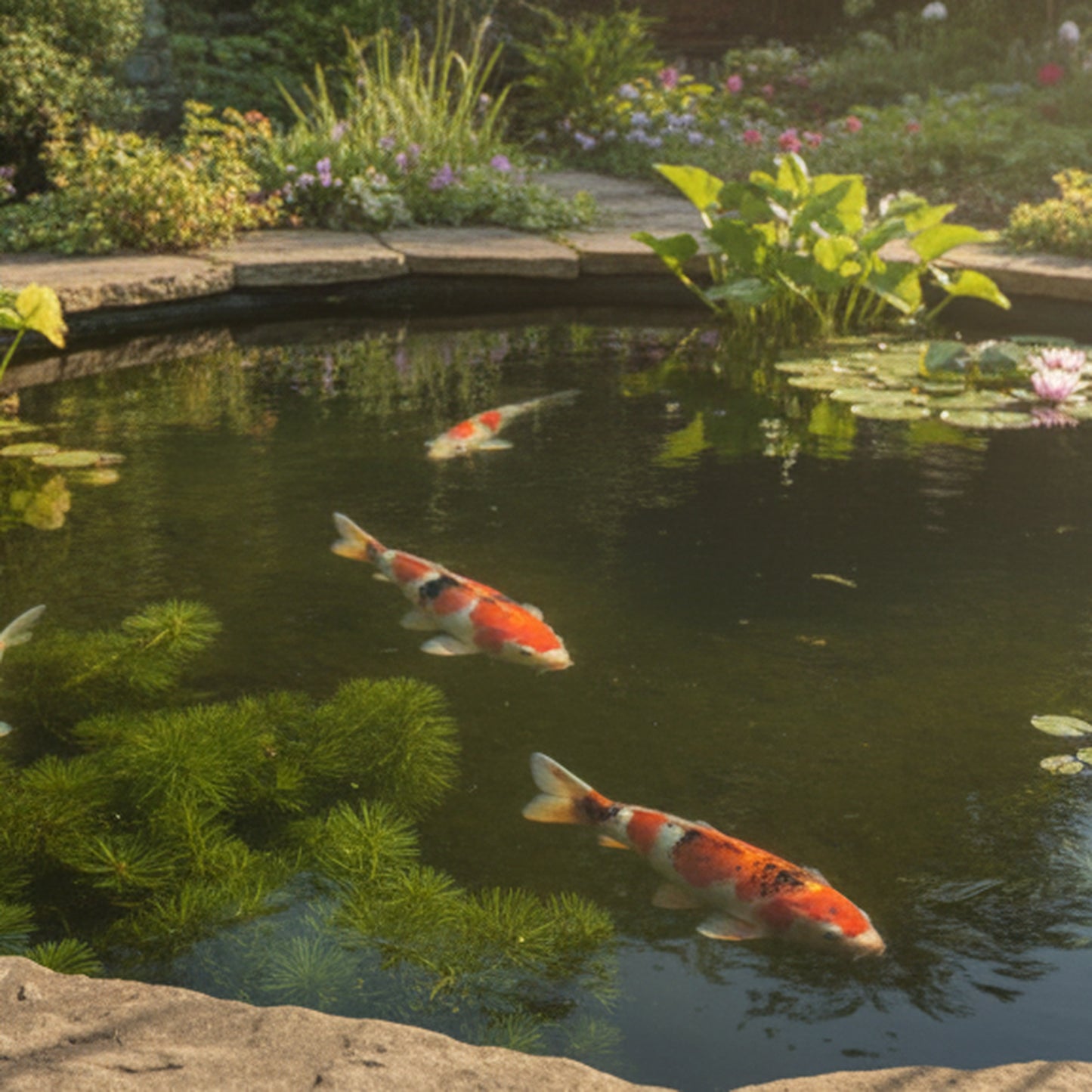
Oxygenating Pond Plants: The Most Natural Way to Improve Pond Water Quality
Oxygenating pond plants are the single most effective long-term investment you can make in your pond's health. During daylight hours, submerged aquatic plants release oxygen directly into the water column through photosynthesis — raising dissolved oxygen levels where fish breathe and beneficial bacteria work. Simultaneously, they absorb the excess nitrates and phosphates that feed algae, providing biological competition that no chemical treatment can replicate sustainably.
Why Submerged Plants Outperform Mechanical Aeration Alone
Pumps and air stones raise oxygen levels, but they do nothing to reduce the nutrient load that drives algae growth. Oxygenating plants address both simultaneously. In a well-planted pond, nutrient levels stabilise, green water becomes less frequent, and blanket weed growth slows — not through chemical intervention but through a functioning aquatic ecosystem where plants and fish exist in balance.
The root systems of submerged plants also provide critical habitat. Beneficial invertebrates — water fleas, freshwater shrimp, and aquatic insect larvae — colonise plant stems within weeks. These invertebrates form the base of the pond food chain, feeding smaller fish and attracting visiting wildlife including newts, frogs, and kingfishers.
Species Typically Included
| Species |
Growth Habit |
Primary Benefit |
Depth Range |
| Hornwort (Ceratophyllum demersum) |
Free-floating |
Rapid oxygenation |
0.3–1.5m |
| Curled Pondweed (Potamogeton crispus) |
Rooted |
Hardy year-round growth |
0.1–0.6m |
| Water Crowfoot (Ranunculus aquatilis) |
Rooted / trailing |
Wildlife habitat, surface cover |
0.1–0.8m |
| Spiked Water Milfoil (Myriophyllum spicatum) |
Rooted |
Fine-textured, koi-compatible |
0.2–0.8m |
| Mare's Tail (Hippuris vulgaris) |
Emergent |
Marginal oxygenation |
0–0.3m |
How Many Plants Do You Need?
As a general guideline, aim for oxygenating plant coverage equivalent to approximately one third of your pond's surface area. For a pond of up to 2,500 litres the 5-plant pack provides a solid starting colony. For larger ponds (up to 5,000 litres) or koi ponds where fish grazing reduces plant density, the 10-plant pack establishes faster and maintains coverage more reliably through the first season.
Planting and Establishment
Place bunches into aquatic planting baskets using purpose-made aquatic compost, topped with a layer of washed pea gravel to prevent soil dispersal. Submerge to the species-appropriate depth. Plants establish fastest in late spring to early summer when water temperatures are rising — this is the optimal planting window for UK conditions.
In koi ponds specifically, protect newly planted baskets with a small mesh guard for the first few weeks while plants take root. Once established, most species become robust enough to withstand light koi attention.
Frequently Asked Questions
Are these plants safe for koi?
Yes. All species included are selected for compatibility with koi ponds. Koi will browse on plant matter as part of their natural behaviour, but the varieties chosen are sufficiently robust to recover from light grazing once established.
Will they survive a UK winter?
Yes — all species are native or naturalised UK aquatic plants, fully adapted to British winters. Most die back to the rootstock in autumn and regenerate in spring. Hornwort remains active at lower temperatures and continues providing some oxygenation throughout winter.
Do oxygenating plants work overnight?
Plants photosynthesise only in daylight. At night, they consume a small amount of oxygen through respiration. In a well-planted, well-stocked pond this is negligible — but if oxygen levels are critically low at dawn, an air stone running overnight provides additional support during the establishment period.
Can I put them straight in without baskets?
Free-floating species like hornwort can simply be placed in the water. Rooted species establish better and are less disruptive to pond substrate when planted in baskets. Loose planting risks koi disturbing the soil and clouding the water.
How quickly will I see water quality improve?
Most pond keepers notice improved clarity within three to four weeks as plants establish and begin competing with algae for nutrients. Full benefit builds over a full growing season as root systems develop and plant density increases.
Free UK delivery. UK grown. Koi-safe varieties. Wildlife pond friendly.