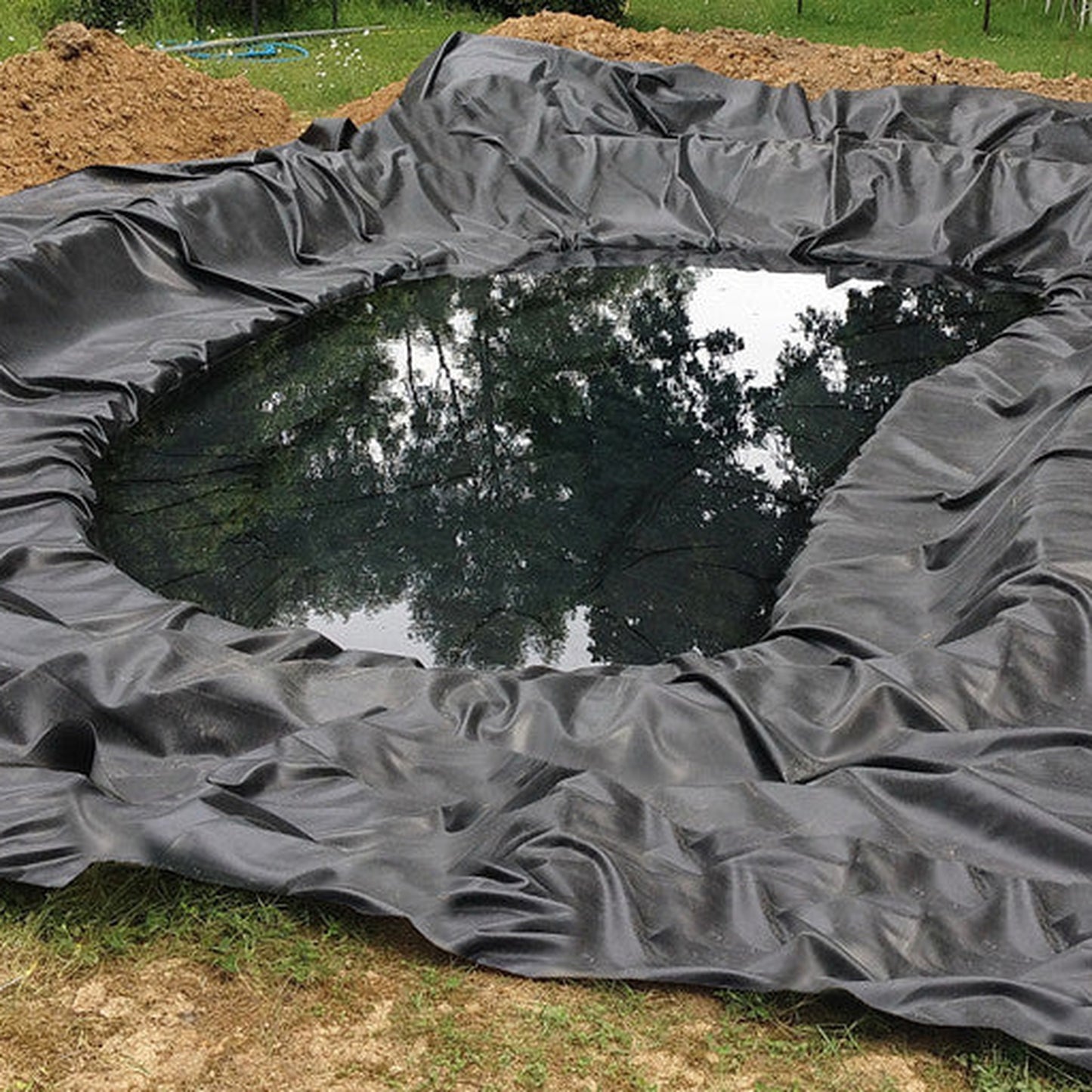
HDPE Pond Liner UK — Heavy Duty | UV Stabilised | Long Guarantee | Fish Safe | Free Delivery
For large-scale pond projects, commercial water features, and installations requiring maximum UV stability and chemical resistance, our HDPE Pond Liner is the professional's choice. High-Density Polyethylene is one of the world's most widely used liner materials for reservoirs, commercial ponds, and large water containment systems — and our HDPE pond liner brings that industrial-grade performance to UK garden and commercial pond installations.
HDPE (High-Density Polyethylene) is engineered for long-term outdoor performance. Its inherent density creates exceptional resistance to UV radiation, chemical attack, and biological degradation — making it the preferred material for ponds where environmental exposure is extreme and liner replacement would be prohibitively expensive.
Full Technical Specifications
Property
Specification
Material
High-Density Polyethylene (HDPE)
Thickness
0.35mm–1.0mm+ (by grade)
Temperature Range
-40°C to +60°C
UV Resistance
Excellent — UV stabilised with carbon black pigment
Fish Safe
✅ Yes — food-grade polyethylene, certified
Guarantee
25–40 Years (by grade)
Chemical Resistance
Outstanding — resists acids, alkalis, oils
Flexibility
Good — less flexible than EPDM; best for regular shapes
Colour
Black (UV-stable carbon black pigment)
Tensile Strength
Excellent
5 Use Cases for HDPE Pond Liner
🏭 Commercial Fish Farms — HDPE's food-grade certification makes it ideal for aquaculture and commercial fish production
💧 Large Agricultural Ponds — Irrigation reservoirs and livestock water storage where long-term chemical resistance is essential
🌊 Canal and Waterway Lining — Commercial waterway projects where HDPE's tensile strength and weldability are required
☀️ High-UV Exposure Sites — Where continuous direct sunlight over decades is a factor — HDPE's UV stabilisation is industry-leading
Step-by-Step Installation Guide
Prepare a smooth substrate — A compacted sand layer of 50–100mm provides the ideal base for HDPE installation
Underlay is essential — Lay 200gsm geotextile underlay before the HDPE liner to protect against stone punctures
Position the HDPE — HDPE is heavier and less flexible — plan carefully before positioning. Large sheets may require additional labour
Seam welding for joins — Where multiple sheets are required, HDPE must be joined by hot-air or extrusion welding — a professional process
Anchor and backfill — HDPE edges are typically anchored in a concrete anchor trench or under concrete coping
Why Choose HDPE?
Industry-leading UV stability via carbon-black pigmentation
Outstanding chemical resistance — resists acids, alkalis, and oils
Dimensional stability — does not creep or deform under load
Weldable — can be heat-welded into any shape for commercial projects
25–40 year guarantees reflecting proven longevity
✅ Trust & Guarantee
✅ Fish Safe Certified — Food-grade polyethylene, safe for all aquatic life
✅ Free UK Delivery — All mainland UK orders delivered free
✅ 25–40 Year Guarantee — Long-term material warranty by grade
✅ Expert Advice Available — Commercial and large-scale project specialists on hand
Frequently Asked Questions
Q: Is HDPE easier or harder to install than EPDM? A: HDPE is less flexible, making it better suited to regular pond shapes. For irregular naturalistic ponds, EPDM is typically easier to install. For rectangular or commercial ponds, HDPE is excellent.
Q: Can I join HDPE myself? A: HDPE joins require heat welding — a professional process. For DIY installations, plan your pond size to use a single HDPE sheet without joins, or use EPDM if joins are needed.
Q: How does HDPE compare to EPDM for a garden pond? A: For standard garden ponds with natural shapes, EPDM is typically the better choice due to superior flexibility. HDPE excels in large, regular-shaped installations and environments with extreme chemical or UV exposure.