




Natural Swimming Pool Liner UK — What You Need to Know (2025)
Share
Quick answer
A natural swimming pool liner must line a deep swimming zone (1.5–2m) and a planted regeneration zone, suit prolonged skin contact and be well anchored under coping. We recommend EPDM rubber, which we sell at 0.75mm and 1.0mm, and advise against PVC because of plasticiser leaching.
Key facts
- NSPs combine a 1.5–2m swimming zone with a planted regeneration zone
- EPDM rubber is our recommended liner; our EPDM is 0.75mm or 1.0mm
- PVC is not recommended because of plasticiser leaching with skin contact
- Anchor the liner under heavy coping; swimming creates uplift forces
- Use bulkhead fittings at every plumbing penetration
Last reviewed: · Reviewed by the PondLinersco.co.uk team
⚡ Quick Answer
EPDM rubber (1.0mm heavy duty) is our recommended liner for UK natural swimming pools. It is certified safe for plants and wildlife, UV-stabilised for 25+ years, and flexible enough for complex swim-zone shapes. A 12m x 5m natural pool typically needs a 16m x 9m liner sheet. Budget between 400 and 900 pounds for liner alone at this size. View our pond liners →
✏️ Last updated: November 2025
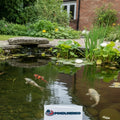
Natural swimming pools (NSPs) — also called swimming ponds — combine a swimming zone with a biological filtration zone planted with aquatic plants. The liner specification for an NSP is more demanding than a standard garden pond: it must be certified safe for prolonged human skin contact, capable of spanning large areas, and resistant to the higher physical stresses of swimming use. EPDM rubber is the standard liner choice for UK natural swimming pool installations.
What Is a Natural Swimming Pool?
A natural swimming pool replaces chemical filtration (chlorine/UV) with biological filtration — a planted zone where aquatic plants and microorganisms clean the water naturally. The design typically features:
- A swimming zone (deeper, 1.5–2m) with a liner base and smooth edges for safe swimming
- A regeneration zone — shallower planted area where biological filtration occurs
- A circulation system that moves water from the swimming zone through the regeneration zone
Natural swimming pools are increasingly popular in the UK as a sustainable alternative to conventional swimming pools, particularly for rural properties where planning permission for a conventional pool may be difficult to obtain.
Liner Requirements for Natural Swimming Pools
An NSP liner faces demands not encountered in standard garden ponds:
- Human contact safety: Prolonged skin contact with the liner surface — the liner must contain no compounds harmful to human skin
- Physical abrasion resistance: Feet, hands, and occasional diving impact create surface abrasion
- Large spans: NSPs are typically 40–150m² or larger — seam quality and panel joining is critical
- Smooth surface: The swimming zone liner should be smooth enough not to cause skin abrasion
Liner Options for Natural Swimming Pools
| Liner Type | Suitable for NSP? | Key Advantage | Key Limitation |
|---|---|---|---|
| EPDM 1.0mm heavy duty (fish-safe grade) | ✅ Excellent — industry standard | Flexible, fish-safe, human-safe, lifetime guarantee | Seams require careful execution on large areas |
| HDPE 1.0mm | ✅ Good for formal designs | Very long lifespan, professional seams | Requires professional installation; less flexible |
| Concrete + EPDM overlay | ✅ Premium approach | Rigid substrate + flexible liner | Highest cost; most complex installation |
| PVC | ❌ Not recommended | Lower cost | Plasticiser leaching risk with prolonged skin contact |
| Butyl rubber | ⚠️ Acceptable | Good track record in ponds | Slightly less UV resistant than EPDM |
Key Design Considerations for NSP Liner Installation
Depth Profile and Liner Shape
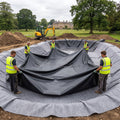
The transition from the swimming zone to the regeneration zone requires careful liner installation to prevent a trip hazard at the step. The liner must follow a smooth profile without sharp ridges or folds at the transition point.
Edge Treatment
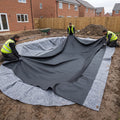
NSP edges are typically finished with natural stone coping, timber decking, or grass edges. The liner must be properly anchored under heavy coping stones — water movement from swimming creates uplift forces greater than a static pond.
Penetrations for Circulation
NSPs typically require several plumbing penetrations for circulation and skimmer systems. Use purpose-designed stainless steel or EPDM-compatible bulkhead fittings at every penetration point.
📚 Related Guides
📚 Related Guides
Related Pond Liner Guides
Shop Pond Liners UK — All Types In Stock
Browse our full range of pond liners — HDPE, EPDM, Butyl, PVC, LDPE and Polyex. All fish safe, UV resistant, and cut to your exact size. Free UK delivery.
Depth Requirements for Natural Swimming Ponds
Natural swimming ponds in the UK typically follow these depth guidelines:
- Swimming zone: Minimum 1.5m deep (ideally 1.8–2.0m for comfortable swimming and thermal stability)
- Regeneration/planting zone: 0.3–0.8m deep (shallow enough for emergent plant species)
- Marginal shelves: 150–300mm depth for marginal planting
These depths affect liner size significantly. Always use the formula: liner length = pond length + (2 × maximum depth) + 0.6m, and the same for width.
How Much Liner Do You Need?
For a typical UK natural swimming pond of 10m × 6m with a 1.8m deep swimming zone:
- Liner length: 10m + (2 × 1.8m) + 0.6m = 14.2m
- Liner width: 6m + (2 × 1.8m) + 0.6m = 10.2m
Round up to the next available size — you can trim excess but cannot add material.
Underlay: Essential for Swim Ponds
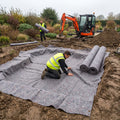
Swim ponds see foot traffic, plant root pressure and possible stone migration, so always lay a geotextile underlay beneath the liner. Use 200gsm needle-punched geotextile, ordered in the same size as the liner, and overlap any joins by at least 300mm.