






HDPE Pond Liner | Industrial Grade | 25 Year Guarantee
HDPE Pond Liner | Industrial Grade | 25 Year Guarantee
Not sure which size? Find my size
Enter your pond's longest length, widest width and deepest point in metres.
Couldn't load pickup availability
Need Help? Get in Touch
HDPE Pond Liner UK — Heavy Duty | UV Stabilised | Long Guarantee | Fish Safe
For large-scale pond projects, commercial water features, and installations requiring maximum UV stability and chemical resistance, our HDPE Pond Liner is the professional's choice. High-Density Polyethylene is one of the world's most widely used liner materials for reservoirs, commercial ponds, and large water containment systems — and our HDPE pond liner brings that industrial-grade performance to UK garden and commercial pond installations.
HDPE (High-Density Polyethylene) is engineered for long-term outdoor performance. Its inherent density creates exceptional resistance to UV radiation, chemical attack, and biological degradation — making it the preferred material for ponds where environmental exposure is extreme and liner replacement would be prohibitively expensive.
HDPE Pond Liner 0.35mm — Key Facts
- Material: HDPE (high-density polyethylene), black, UV stabilised
- Thickness (this listing): 0.35mm (350 microns)
- Sizes: 51 sizes, from 2.5m x 2.5m (6.25m²) up to 30m x 40m (1,200m²)
- Guarantee: 25 years
- Underlay: not included. Lay our 200gsm pond liner underlay first
- Best for: large ponds, formal and rectangular ponds, agricultural and commercial ponds, reservoirs and ponds in full sun
- Consider EPDM instead if: your pond has tight curves, lots of shelves or a naturalistic shape. See our EPDM pond liners
- Sold by: PondLinersco.co.uk (Express Matting Services Ltd, Burnley, Lancashire, UK)
Full Technical Specifications
| Property | Specification |
|---|---|
| Material | High-Density Polyethylene (HDPE) |
| Thickness | 0.35mm–1.0mm+ (by grade) |
| Temperature Range | -40°C to +60°C |
| UV Resistance | Excellent — UV stabilised with carbon black pigment |
| Fish Safe | ✅ Yes — food-grade polyethylene, certified |
| Guarantee | 25–40 Years (by grade) |
| Chemical Resistance | Outstanding — resists acids, alkalis, oils |
| Flexibility | Good — less flexible than EPDM; best for regular shapes |
| Colour | Black (UV-stable carbon black pigment) |
| Tensile Strength | Excellent |
5 Use Cases for HDPE Pond Liner
- 🏭 Commercial Fish Farms — HDPE's food-grade certification makes it ideal for aquaculture and commercial fish production
- 💧 Large Agricultural Ponds — Irrigation reservoirs and livestock water storage where long-term chemical resistance is essential
- 🌊 Canal and Waterway Lining — Commercial waterway projects where HDPE's tensile strength and weldability are required
- 🏗️ Formal Concrete-Edged Ponds — HDPE's dimensional stability suits rectangular and regular-shaped formal ponds
- ☀️ High-UV Exposure Sites — Where continuous direct sunlight over decades is a factor — HDPE's UV stabilisation is industry-leading
Step-by-Step Installation Guide
- Prepare a smooth substrate — A compacted sand layer of 50–100mm provides the ideal base for HDPE installation
- Underlay is essential — Lay 200gsm geotextile underlay before the HDPE liner to protect against stone punctures
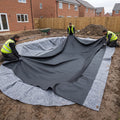
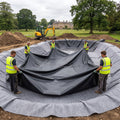
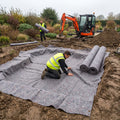
- Position the HDPE — HDPE is heavier and less flexible — plan carefully before positioning. Large sheets may require additional labour
- Seam welding for joins — Where multiple sheets are required, HDPE must be joined by hot-air or extrusion welding — a professional process
- Anchor and backfill — HDPE edges are typically anchored in a concrete anchor trench or under concrete coping
Why Choose HDPE?
- Industry-leading UV stability via carbon-black pigmentation
- Outstanding chemical resistance — resists acids, alkalis, and oils
- Dimensional stability — does not creep or deform under load
- Weldable — can be heat-welded into any shape for commercial projects
- 25–40 year guarantees reflecting proven longevity
✅ Trust & Guarantee
- ✅ Fish Safe Certified — Food-grade polyethylene, safe for all aquatic life
- ✅ 25–40 Year Guarantee — Long-term material warranty by grade
- ✅ Expert Advice Available — Commercial and large-scale project specialists on hand
Frequently Asked Questions
Q: Is HDPE easier or harder to install than EPDM?
A: HDPE is less flexible, making it better suited to regular pond shapes. For irregular naturalistic ponds, EPDM is typically easier to install. For rectangular or commercial ponds, HDPE is excellent.
Q: Can I join HDPE myself?
A: HDPE joins require heat welding — a professional process. For DIY installations, plan your pond size to use a single HDPE sheet without joins, or use EPDM if joins are needed.
Q: How does HDPE compare to EPDM for a garden pond?
A: For standard garden ponds with natural shapes, EPDM is typically the better choice due to superior flexibility. HDPE excels in large, regular-shaped installations and environments with extreme chemical or UV exposure.
What Size HDPE Pond Liner Do I Need?
Measure the longest length, the widest width and the deepest point of your pond, then use this formula for each direction:
Liner length = pond length + (2 x maximum depth) + 0.6m
Liner width = pond width + (2 x maximum depth) + 0.6m
The extra 0.6m gives a 30cm overlap on every edge for anchoring. If you fall between sizes, always choose the next size up. A size works either way round, so a 4m x 5m liner also covers a 5m x 4m requirement.
- Garden pond 3m x 2m, 0.6m deep: 3 + 1.2 + 0.6 = 4.8m and 2 + 1.2 + 0.6 = 3.8m, so order 4m x 5m
- Koi pond 6m x 4m, 1.5m deep: 6 + 3 + 0.6 = 9.6m and 4 + 3 + 0.6 = 7.6m, so order 8m x 10m
For shelves, sloped sides and irregular shapes, follow our guide How to Measure a Pond for Liner or use the pond liner size calculator.
HDPE vs EPDM vs Butyl vs PVC Pond Liner
| Liner | Flexibility | Best suited to |
|---|---|---|
| HDPE (this liner) | Stiffer; best laid in regular shapes | Large, formal, rectangular, agricultural and commercial ponds; sites in full sun |
| EPDM rubber | Very flexible and stretchy | Garden and wildlife ponds with curves and shelves |
| Butyl rubber | Very flexible | Garden and koi ponds of any shape |
| PVC | Flexible | Small garden ponds and water features on a budget |
Full comparisons: Butyl vs EPDM vs HDPE Pond Liner and HDPE vs PVC vs LDPE Pond Liner.
Which HDPE Pond Liner Should I Choose?
- This 0.35mm HDPE pond liner for large or regular-shaped ponds where you want a 25-year guarantee and will lay your own underlay.
- HDPE Pond Liner | 40 Year Guarantee | Heavy Duty if you want the 40-year guarantee version.
- EPDM pond liners for curved, naturalistic or heavily shelved garden ponds.
- Browse every option in our HDPE pond liners range.
More Questions About HDPE Pond Liner
Is HDPE pond liner fish safe?
Yes. HDPE (High-Density Polyethylene) pond liner is fish-safe and chemically inert. It does not leach harmful compounds into pond water and is safe for fish, amphibians, and other pond wildlife. It is widely used in commercial aquaculture installations.
What is HDPE pond liner used for?
HDPE pond liner is primarily used for large commercial ponds, agricultural reservoirs, irrigation ponds, and industrial containment. It offers excellent chemical resistance and longevity. For smaller garden ponds, EPDM rubber typically offers better flexibility and ease of installation.
How long does HDPE pond liner last?
HDPE pond liner carries a 25–40 year guarantee from UK suppliers, depending on the grade. Its chemical stability and resistance to UV degradation make it one of the longest-lasting liner materials for large-scale applications.
Is HDPE or EPDM better for a garden pond?
For typical garden ponds, EPDM rubber is generally the better choice. EPDM is more flexible — it conforms easily to curved and irregular shapes — and is easier to install in domestic settings. HDPE is stiffer and better suited to large, regularly shaped commercial or agricultural ponds.
Does HDPE pond liner need an underlay?
Yes. A geotextile underlay is recommended beneath HDPE pond liner to protect against stone puncture and root intrusion. For garden pond applications, a 200gsm underlay is appropriate. For commercial or industrial ponds on rocky ground, 300–500gsm geotextile is recommended.
How thick is this HDPE pond liner?
This listing is 0.35mm (350 microns) high-density polyethylene. It comes in 51 sizes, from 2.5m x 2.5m up to 30m x 40m.
Is underlay included with this HDPE pond liner?
No. Underlay is not included with this liner. Lay a geotextile underlay before the liner; our 200gsm pond liner underlay suits most garden ponds.
What size HDPE pond liner do I need for a 3m x 2m pond?
For a 3m x 2m pond that is 0.6m deep you need at least 4.8m x 3.8m of liner, so order the 4m x 5m size. The formula is pond length (or width) + (2 x maximum depth) + 0.6m.
What is the largest HDPE pond liner size available?
The largest standard size is 30m x 40m (1,200m²). For larger or bespoke projects, contact our team for advice.
Can I trim HDPE pond liner to shape?
Yes. Leave the excess in place until the pond is filled and settled, then trim it with a sharp utility knife, keeping enough overlap to anchor the edge under coping, slabs or in an anchor trench.
Helpful HDPE Pond Liner Guides


Premium products only
SSL encrypted checkout
30-day return policy
Pond specialists on hand
Need Help Choosing the Right Product?
Our pond specialists are here to help. Get free, no-obligation advice for your pond project.